


Top Banner
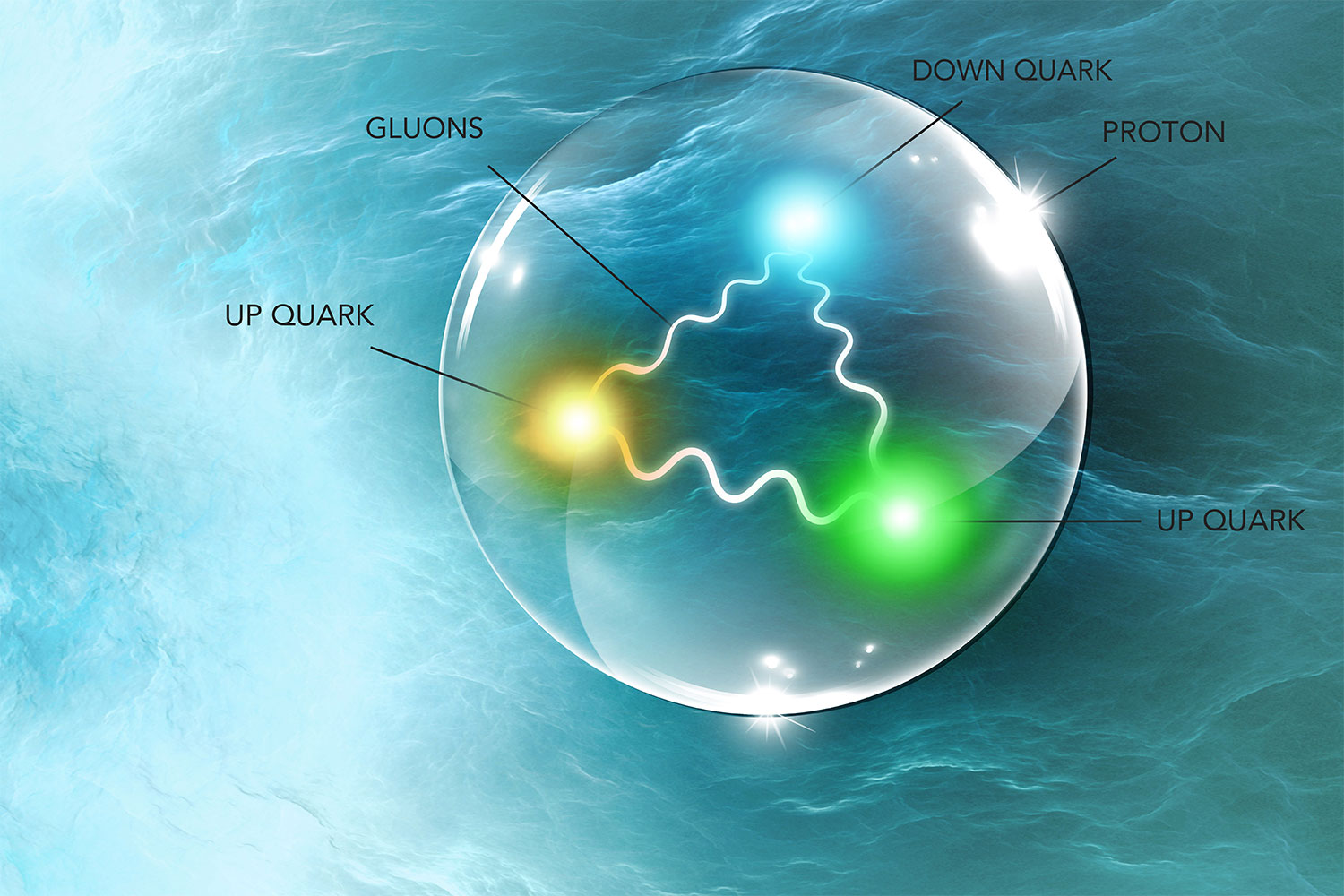
The femtoscale structure of nuclear systems is described by generalized parton distributions (GPDs), which quantify the likelihood of removing and returning a quark or gluon without breaking the target. They encode spatial distributions of quarks and gluons, the decomposition of energy and angular momentum, and the internal forces within nuclei.
Femtography is measured in high-energy exclusive 2→3 reactions that probe how nuclear systems respond without being destroyed. In deeply virtual Compton scattering, quantum interference between photon emission from the electron or proton creates a fringe pattern in the scattering rate that is sensitive to GPDs.
The Generalized Universal Moment Parametrization (GUMP) is a physics-informed approach to modeling GPDs that is informed by the symmetries of the strong nuclear interaction and that guarantees known physical properties of hadrons. GUMP accordingly provides realistic parametrizations of the GPDs with minimal free parameters, decreasing the latent space for fits of GPDs to data.
Generalized parton distributions (GPDs) map how charge, energy, momentum, spin, and forces are distributed within a hadron. They also reveal how quarks and gluons move along the line of sight, providing 3D images consisting of a 2D spatial density and a particle speed distribution.